Person leaning on a car watching the sunset over the ocean.

The EU tyre label

The EU is pursuing the goal of creating an energy union with a future-oriented climate policy. Fuel efficiency, and thus also fuel-efficient tyres, are important factors for climate and energy policy leading up to 2030. The EU tyre label is intended to provide you with orientation and make your purchasing decisions easier.

Tyre information under Regulation (EU) 2020/740. The tyre information labels show the different types of tyre which could be fitted to your vehicle during production. Please note that we cannot advise you which particular type of tyre (from the selection shown) will be fitted to any particular vehicle and you will not be able to choose a particular type of tyre. All tyre information shown is provided by a third party and we cannot guarantee its accuracy – if you have any questions regarding tyre specifications please speak to your local Audi Centre.


Locate a Centre

Introduction of the label

The goal: a future-oriented climate policy. In order to achieve this, the EU is aiming, among other things, to reduce CO2 emissions from road traffic.

The use of fuel-efficient tyres can advance this mission and thereby reduce CO2 emissions from road transport. In order to provide you with comparative information regarding fuel efficiency, safety and rolling noise before you buy a tyre, the EU is improving tyre labelling. With Regulation (EU) 2020/740, the EU introduced the new EU tyre label on 1 May 2021.

A close-up of a blue car's front wheel and headlight, with "e-tron" badge, on a dirt road surrounded by nature.

What changes for you?

The EU tyre label provides a basis for making an informed decision for more fuel-efficient tyres. The tyre labelling enables comparison of relevant information. Consumers can benefit in terms of reducing costs and CO2 emissions while also making an environmentally friendly purchase decision.
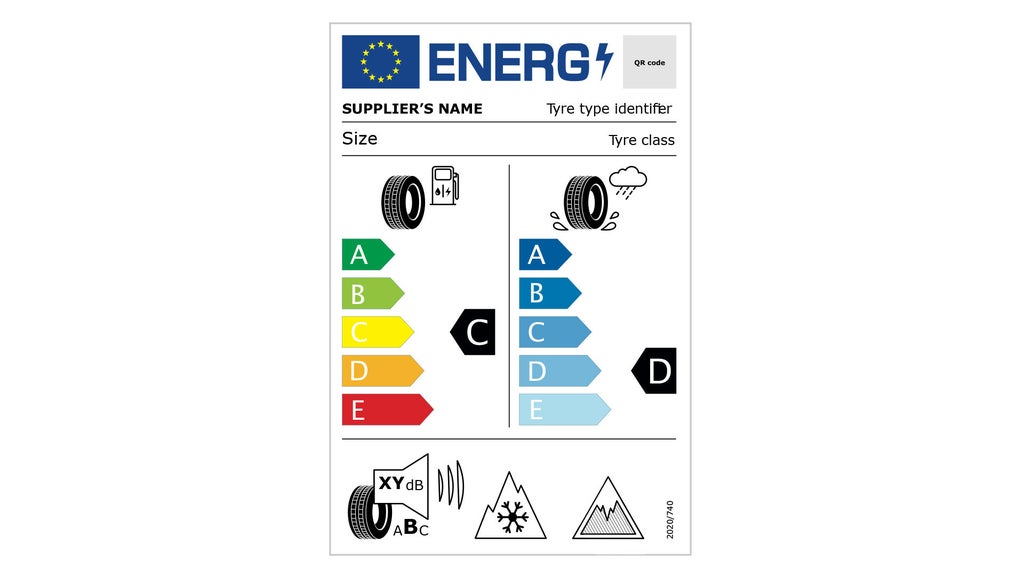

EU tyre label from May 2021 onwards
Previous EU tyre label

> The regulation (EU) 2020/740 of 25 May 2020 will also apply to bus and truck tyres (tyre classes C1, C2, C3) in addition to car tyres
> Presentation of additional information on the tyre label (tyre type identifier = Art.no.)
> The QR code for each tyre type identifier with a link to the EU product database (EPREL) is in the upper right corner
> Rescaling for the lower label classes: D is the new E; Class D is no longer empty (affects only C1 and C2 tyres); F and G merge into E
> New noise class display: ABC classification instead of sound waves
> New pictograms: Snow (3PMSF) and ice logo, ice logo only for C1 tyres (passenger cars)
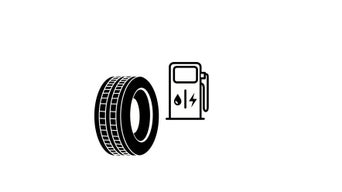
Icon representing tyre fuel efficiency, featuring a tyre and fuel pump symbol on a light background, illustrating the relationship between tyre rolling resistance and vehicle energy consumption.

Fuel efficiency

The fuel efficiency class of the tyres varies depending on the rolling resistance between the following grades. <br><br> > A are the most efficient tyres and save fuel <br><br> > E are the least efficient tyres and consume the most fuel

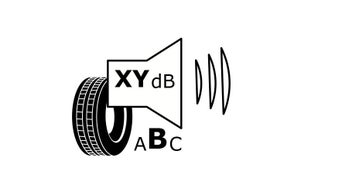
Icon representing tyre rolling noise, featuring a tyre, sound level indicator, and sound wave symbols, illustrating external tyre noise performance measured in decibels and classified by noise rating.

Rolling noise

The rolling noise of the tyres or the outside noise level is measured in decibels (dB) and is given with a number instead of XY. <br><br> In addition, the rolling noise is divided into three levels: A, B, and C.

Icon representing tyre wet grip performance, featuring a tyre with water splashes and a rain cloud, illustrating the tyre's ability to maintain traction and braking performance on wet road surfaces.

Wet grip

The wet grip class provides information about the braking properties in wet weather conditions and ranges from <br><br> > A (greatest safety) to <br><br> > E (least safety).

Icon representing tyre snow grip performance, featuring a mountain and snowflake symbol, indicating that the tyre is certified for use in severe snow conditions and enhanced winter traction.

Snow grip

Tyres marked with this symbol are suitable for use in extreme snow conditions.

Icon representing tyre ice grip performance, featuring a mountain symbol within a triangular sign, indicating that the tyre is certified for enhanced traction and braking performance on icy road surfaces.

Ice grip

Tyres marked with this symbol are designed for road surfaces with a layer of ice or a solid snow cover. <br><br> Ice tyres are designed for road surfaces with a layer of ice or a solid snow cover and should only be used in very difficult weather conditions (e.g., low temperatures). The use of ice tyres in less difficult weather conditions (e.g., wet or warmer temperatures) can lead to suboptimal performance, especially with regard to wet grip, handling, and wear.

Icon representing additional tyre information, featuring a circular information symbol, indicating that further notes, explanations, or supplementary tyre performance details are available.

Further notes

Fuel consumption can be significantly reduced by driving in an environmentally friendly manner. <br><br> To improve fuel efficiency and wet grip, it is important to regularly check the tyre pressure. <br><br> The stopping distances must always be observed.

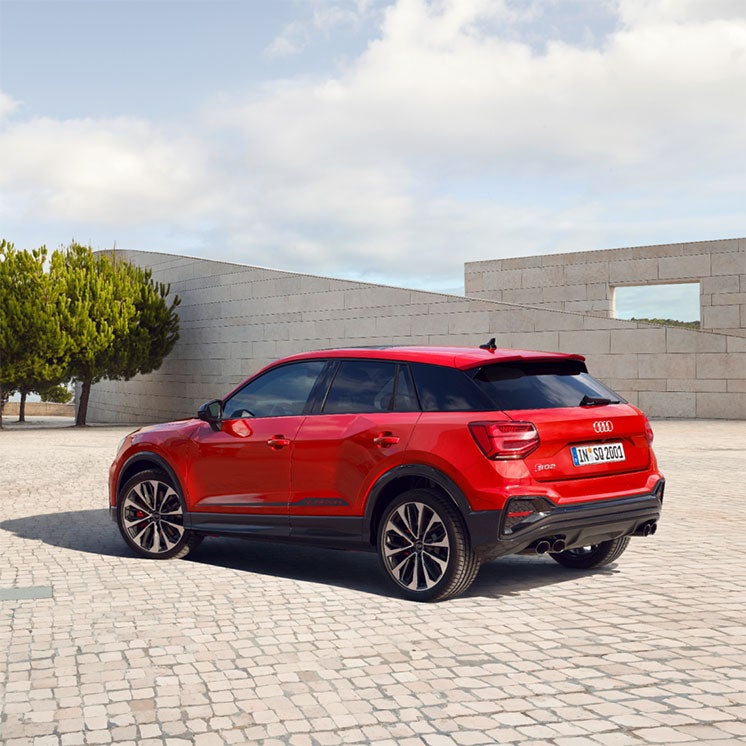
Red Audi SUV parked on cobblestone pavement with trees and modern architecture in the background.

Website of the EU commission

For more information on the EU Tyre Labelling Regulation, please visit the website of the European Commission.

Loading..